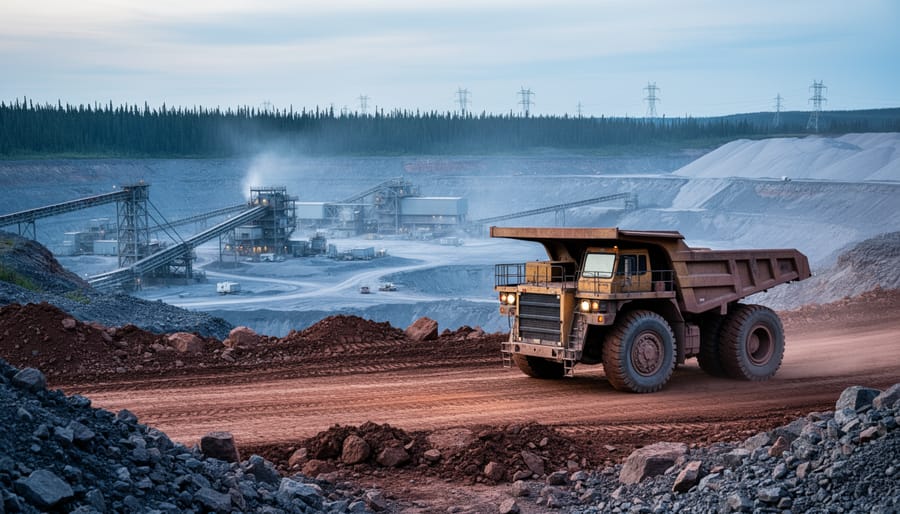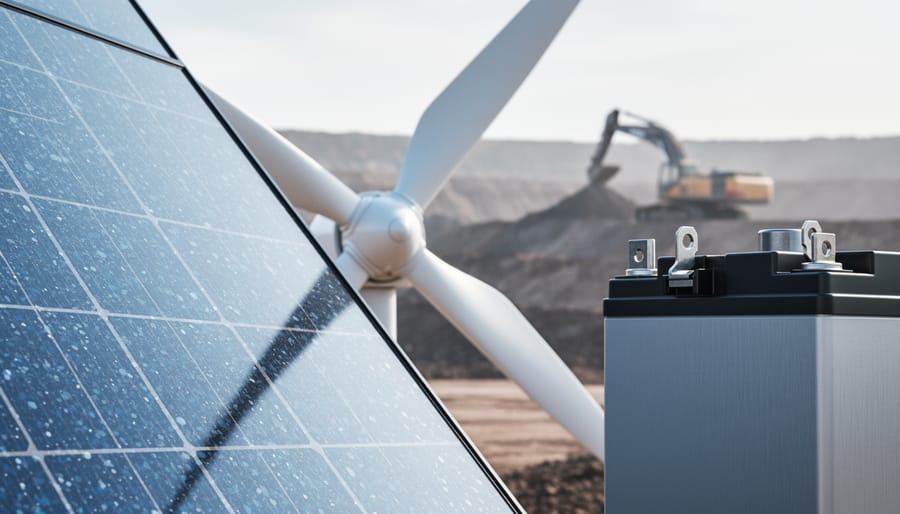
The most likely reason you’re wrestling with this question is simple: renewable energy infrastructure cannot exist without non-renewable resources. Solar panels require mined silver and silicon. Wind turbines demand rare earth elements and steel. Battery storage systems depend on lithium, cobalt, and nickel extracted from the earth. This isn’t a flaw in the clean energy transition. It’s the material reality of building any technology at scale.
The cognitive dissonance many Canadians feel when learning that “green” technology depends on mining is valid, but misplaced. Non-renewable resources remain critically important in 2026 because they provide the foundational materials for the very infrastructure designed to reduce our reliance on fossil fuels. The real problem isn’t that we mine these materials. It’s how we mine them, who bears the environmental and social costs, and whether we’re designing systems to recover and reuse those materials indefinitely.
Indigenous communities across Canada have long understood this balance. Traditional knowledge systems recognize that taking from the earth carries responsibility: minimize harm, use only what’s needed, and ensure benefits flow to those most affected. Modern resource extraction has rarely honored these principles, but the path forward requires integrating them into every stage of the supply chain.
This troubleshooting guide diagnoses why non-renewable resources remain essential, examines the material science constraints that create this dependency, and maps practical solutions through responsible sourcing and circular economy principles. You’ll learn how to evaluate mining projects against sustainability criteria, identify companies leading ethical extraction practices, and understand policy mechanisms that can transform resource extraction from extractive harm to regenerative partnership. The clean energy transition isn’t about eliminating our need for mined materials. It’s about reimagining how we obtain and steward them.
Understanding the Non-Renewable Foundation of Renewable Energy
The Material Reality of Clean Technology
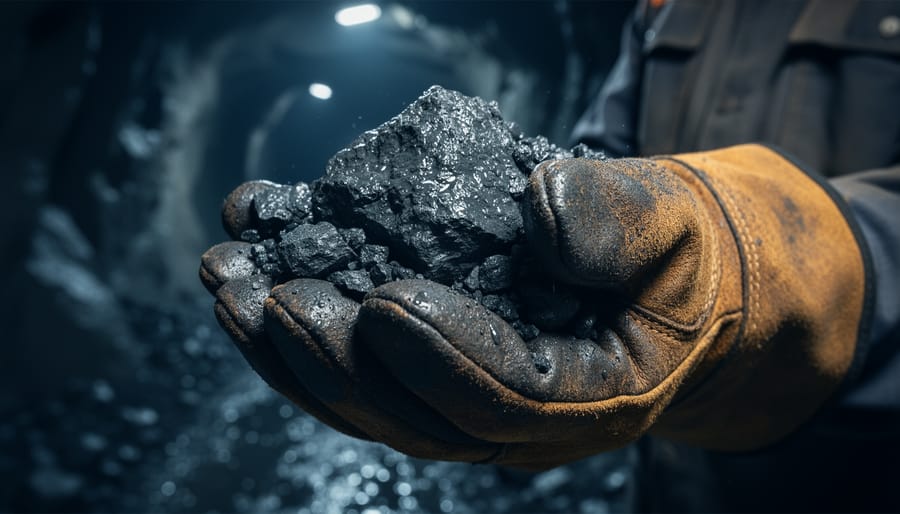
Every solar panel, wind turbine, and electric vehicle battery represents a carefully orchestrated combination of Earth’s finite materials. A single 3-megawatt wind turbine contains approximately 4.7 tonnes of copper for electrical wiring and components, plus 600 kilograms of neodymium and dysprosium, rare earth elements that create powerful permanent magnets essential for efficient energy generation. Without these magnets, turbines would need to be substantially larger and heavier to produce the same output.
Battery technology presents an even more material-intensive reality. An electric vehicle battery pack requires roughly 8 kilograms of lithium, 35 kilograms of nickel, 20 kilograms of manganese, and 14 kilograms of cobalt. Scale this to grid storage systems, and the numbers multiply exponentially. A utility-scale battery facility storing 100 megawatt-hours demands approximately 11,000 kilograms of lithium alone.
Solar panels depend on highly purified silicon, processed from quartz through energy-intensive refinement, alongside silver for electrical contacts. One solar panel uses about 20 grams of silver, which sounds minimal until you consider installations spanning thousands of panels.
The International Energy Agency projects that mineral demand for clean energy technologies could increase by 400% by 2040 under current policy scenarios. Meeting climate targets would push this even higher. Canada’s mining sector sits at the intersection of this demand, holding substantial nickel reserves in Ontario and Quebec, copper deposits across British Columbia, and emerging lithium projects in Alberta and the Northwest Territories.
Why We Need Non-Renewable Resources: Likely Causes of Dependency
Nickel’s Unique Role in Energy Storage
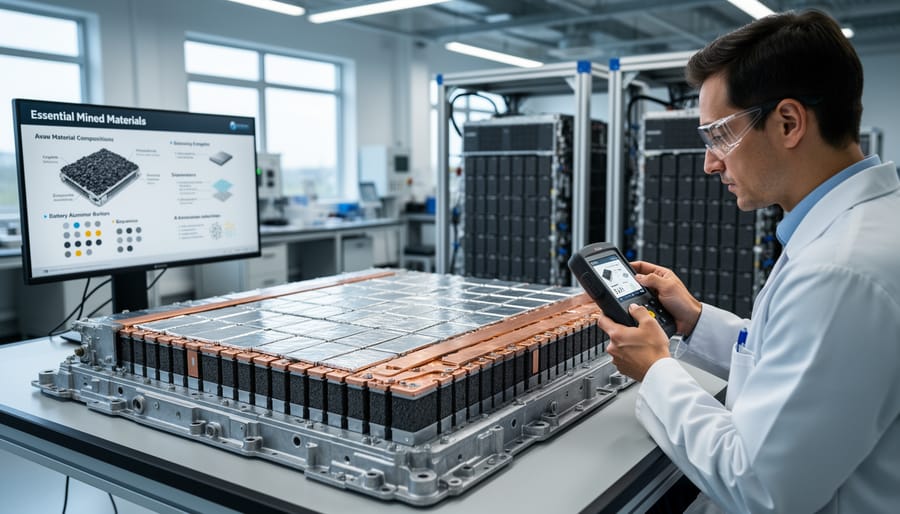
Nickel stands at the heart of modern battery technology because of its unique atomic structure and electrochemical properties. In lithium-ion batteries, nickel serves as the primary cathode material, enabling higher energy density than alternatives like cobalt or manganese-based chemistries. This translates directly into longer driving ranges for electric vehicles and more compact storage systems for renewable energy grids.
The chemistry is straightforward but powerful. Nickel-rich cathodes, particularly NMC (nickel-manganese-cobalt) and NCA (nickel-cobalt-aluminum) formulations, can store more lithium ions per unit of mass. Current industry-standard batteries use 80% nickel content, with researchers pushing toward 90% to maximize performance. A Tesla Model 3 battery pack contains approximately 50 kilograms of nickel, while utility-scale grid storage projects require thousands of tonnes.
Beyond energy density, nickel enhances battery lifespan and thermal stability. It maintains structural integrity through repeated charge-discharge cycles, crucial for vehicles expected to last 15 years or more. The material also operates efficiently across wide temperature ranges, from Canadian winters to desert heat.
Canada holds the world’s third-largest nickel reserves, concentrated in Ontario, Manitoba, and Quebec. Sudbury’s mining operations have supplied nickel for over a century, positioning the region as a strategic supplier for North America’s battery manufacturing boom. This domestic advantage reduces supply chain vulnerabilities while enabling stronger environmental and social governance standards compared to some international sources.
Copper, Lithium, and Other Critical Materials
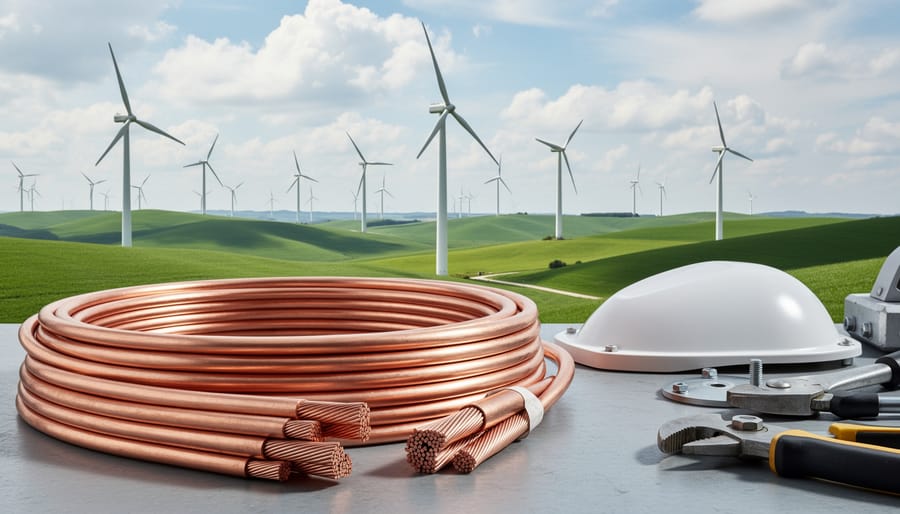
Copper forms the circulatory system of renewable energy infrastructure. Its exceptional electrical conductivity makes it irreplaceable in wind turbine generators, solar panel wiring, and electric vehicle charging networks. A single offshore wind turbine contains roughly three tonnes of copper, while grid-scale solar installations require approximately five tonnes per megawatt. The global shift to electrified transportation and renewable power generation is projected to double copper demand by 2035.
Lithium powers the battery revolution. This lightweight metal enables high energy density storage essential for electric vehicles and grid stabilization systems that buffer intermittent solar and wind generation. Current lithium-ion technology has no viable substitute that matches its performance-to-weight ratio, making lithium extraction a bottleneck in the clean energy transition.
Rare earth elements, seventeen metallic elements including neodymium, dysprosium, and terbium, create the powerful permanent magnets in direct-drive wind turbines and electric motors. These magnets operate without mechanical gearboxes, improving efficiency and reducing maintenance. China currently controls 60% of global rare earth mining and 85% of processing capacity, creating supply chain vulnerabilities that countries like Canada are working to address through domestic development projects.
Step-by-Step Path to Sustainable Resource Management
Implementing Indigenous-Led Governance Models
Indigenous communities across Canada are redefining how critical minerals reach renewable energy supply chains. Rather than accepting top-down extraction models, First Nations, Inuit, and Métis governments now negotiate as rights-holders with decision-making authority over traditional territories. These partnerships go beyond consultation, they establish shared governance structures where Indigenous knowledge systems inform everything from exploration timelines to reclamation standards.
The Ring of Fire region in Northern Ontario demonstrates this shift in practice. Webequie First Nation and Marten Falls First Nation don’t just consent to chromite and nickel projects; they co-develop them through Impact Benefit Agreements that guarantee employment, contracting opportunities, and revenue sharing. Traditional land-use studies conducted by Elders map seasonal hunting grounds and water systems, creating exclusion zones that protect ecological and cultural sites before a single drill turns.
Co-management extends to monitoring and enforcement. Guardian programs train community members to conduct water quality testing, wildlife surveys, and vegetation assessments throughout a mine’s lifecycle. When baseline data comes from people who’ve harvested medicines and fished these watersheds for generations, deviations get noticed immediately. Companies face accountability not to distant regulators but to neighbours who depend on the land remaining healthy.
This governance model doesn’t slow renewable energy material supply, it makes it more resilient. Projects designed with Indigenous consent from inception face fewer legal challenges, work stoppages, and reputational crises. They also tend to leave smaller ecological footprints because traditional knowledge identifies sensitivities that technical assessments miss.
Advancing Recycling and Circular Economy Solutions
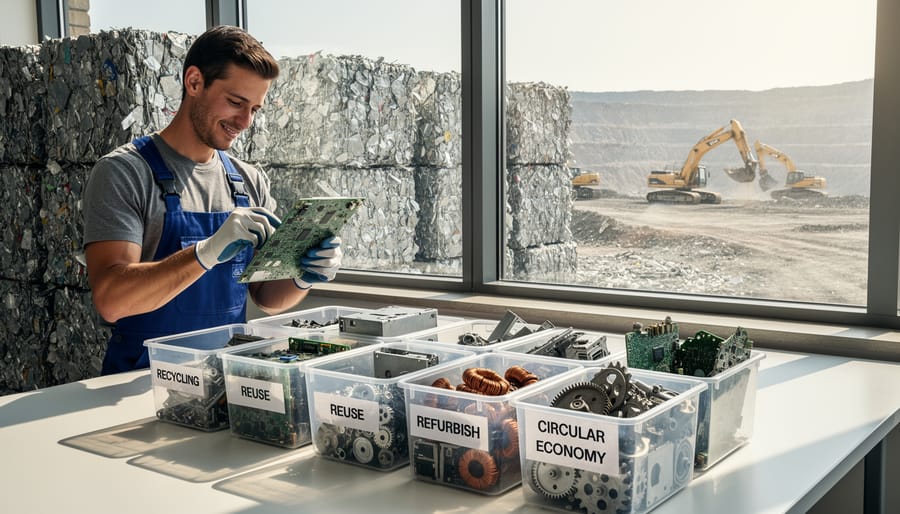
The pressure on primary mining operations eases dramatically when we close the loop on materials already in circulation. Urban mining, extracting valuable minerals from discarded electronics and batteries, represents one of the most promising pathways toward sustainable resource management. A single tonne of circuit boards contains more gold than seventeen tonnes of ore, and modern battery recycling can now recover over 95% of the nickel, cobalt, and lithium from spent cells.
Hydrometallurgical processes currently lead the field, using chemical solutions to selectively dissolve and separate metals. These methods operate at lower temperatures than traditional smelting, cutting energy use by half while capturing materials that older techniques simply burned off. Direct recycling takes this further by preserving the cathode structure itself, essentially refurbishing battery materials rather than breaking them down completely. This approach maintains the crystalline lattice that took significant energy to create in the first place.
Canada has positioned itself at the forefront of this transformation. Li-Cycle’s spoke-and-hub model processes battery black mass across North America, while Quebec’s Innovation Centre focuses specifically on recovering rare earth elements from electronics. The federal Critical Minerals Strategy includes targeted funding for recycling infrastructure, recognizing that recovered materials carry a fraction of the carbon footprint of freshly mined ore.
The economics increasingly favour recovery as well. With lithium prices fluctuating wildly and supply chains vulnerable to geopolitical shifts, manufacturers now design products for disassembly, building tomorrow’s mine into today’s battery pack.
Canada’s Strategic Advantage in Responsible Resource Supply
Canada holds approximately 20% of global nickel reserves, 7% of lithium resources, and significant deposits of cobalt and copper, materials that form the backbone of battery production, electric vehicle manufacturing, and renewable energy infrastructure. This mineral wealth positions the country as a potential anchor in the global clean energy supply chain, but abundance alone doesn’t guarantee leadership. What sets Canada apart is the possibility of coupling resource extraction with rigorous environmental standards and meaningful Indigenous partnership models that other mining jurisdictions have struggled to implement.
The scale of domestic reserves relative to renewable energy demand reveals both opportunity and responsibility. Current production levels lag far behind what Canadian geology could sustainably yield, creating a gap between potential and practice that policy and investment must address.
| Critical Mineral | Canada’s Reserves (% of Global) | 2024 Production | Projected 2030 Demand for Clean Energy |
|---|---|---|---|
| Nickel | 20% | 180,000 tonnes | 3.5 million tonnes globally (Canada could supply 15-18%) |
| Lithium | 7% | Minimal (pre-production) | 2 million tonnes globally (domestic projects in development) |
| Cobalt | 3% | 4,300 tonnes | 300,000 tonnes globally (as nickel by-product) |
| Copper | 3% | 545,000 tonnes | 50 million tonnes globally by 2035 |
The strategic advantage extends beyond geology. Canada’s established regulatory frameworks, existing mining expertise, and political stability make it an attractive alternative to jurisdictions where environmental enforcement is weak or human rights records are questionable. The country’s Critical Minerals Strategy, launched in 2022, explicitly ties resource development to climate goals and reconciliation commitments, creating a policy environment where responsible extraction isn’t an afterthought but a design principle.
Projects like the Ring of Fire in northern Ontario and emerging lithium operations in Quebec and Alberta will test whether this strategic positioning translates into practice. Success depends on whether infrastructure investment, Indigenous consent processes, and environmental assessments can move at a pace that meets global demand without compromising the standards that differentiate Canadian supply. The opportunity is real, but so is the risk of repeating extraction patterns that prioritize speed over stewardship.
Prevention: Building a Sustainable Extraction Future
Material Innovation and Substitution Research
Scientists and engineers are racing to reduce our dependence on scarce minerals through material innovation. Sodium-ion batteries, for instance, replace lithium with abundant sodium, offering a promising alternative for grid storage applications where weight isn’t critical. Researchers at universities across Canada are developing iron-air and zinc-based battery chemistries that could eliminate the need for nickel and cobalt entirely.
In wind turbine technology, teams are engineering permanent magnets that use fewer or no rare earth elements. Some designs rely on electromagnets instead, though with slight efficiency trade-offs. Solar panel innovation focuses on perovskite materials and organic photovoltaics that could eventually reduce silicon requirements.
These breakthroughs won’t happen overnight. Most alternative materials still face hurdles around performance, durability, or manufacturing scale. Sodium batteries, for example, store less energy per kilogram than lithium equivalents. Yet each incremental improvement brings us closer to renewable technologies with smaller mineral footprints. The transition period requires both mining responsibly and investing heavily in the research that will make today’s critical materials less critical tomorrow.
Policy and Certification Standards
Global momentum toward responsible extraction has generated a patchwork of certification frameworks attempting to verify mining practices meet environmental and social standards. The Initiative for Responsible Mining Assurance (IRMA) offers the most comprehensive third-party certification, evaluating mines against 26 principles covering Indigenous rights, biodiversity protection, and worker safety. Several Canadian operations have pursued IRMA certification, though uptake remains limited compared to traditional industry audits.
Traceability systems are evolving rapidly. Blockchain-based platforms now track minerals from mine to manufacturer, creating verifiable supply chain records. The Canadian government’s Critical Minerals Strategy, launched in 2022, established financial incentives for operations adopting these transparency tools while setting procurement preferences for certified materials.
Internationally, the European Union’s Corporate Sustainability Due Diligence Directive mandates companies prove their mineral sources meet human rights and environmental benchmarks. This regulation creates market pressure: producers unable to demonstrate responsible practices risk losing access to major buyers.
Canada has an opportunity to set the global standard rather than merely follow it. Provincial jurisdictions are experimenting with benefit-sharing agreements that legally require mining companies to negotiate with affected Indigenous communities before permits are granted. These frameworks shift power dynamics, making consent meaningful rather than procedural.
Common Questions About Non-Renewable Resources in Clean Energy
Can renewable energy truly be sustainable if it requires mining?
Yes, but sustainability depends on how we extract and manage materials. Renewable energy systems produce clean power for decades using a one-time material input, dramatically reducing lifetime emissions compared to fossil fuels that require continuous extraction and combustion. The key is implementing responsible mining practices, recycling end-of-life components, and continually improving extraction methods.
How long will critical mineral supplies last?
Current geological surveys indicate centuries of available reserves for most critical minerals when accounting for known deposits and improving extraction techniques. The timeline extends further when we factor in recycling, which can recover up to 95% of materials from batteries and electronics, and ongoing substitution research that reduces dependence on any single element.
Are there alternatives to traditional mining for these materials?
Emerging alternatives include urban mining (recovering materials from electronic waste), deep-sea nodule collection, and direct lithium extraction from brine without evaporation ponds. However, conventional mining will remain necessary for the near term, making the focus on responsible extraction methods and Indigenous partnership models essential rather than optional.
What makes Canadian resource extraction different from other countries?
Canada combines strict environmental regulations, meaningful consultation requirements with Indigenous communities, and transparent governance structures that many mining jurisdictions lack. Several provinces have implemented co-management agreements where Indigenous nations hold decision-making authority over projects on their territories, creating accountability that goes beyond voluntary corporate commitments.
How can local communities benefit from mineral extraction projects?
Beyond employment and economic activity, modern Impact and Benefit Agreements in Canada provide communities with revenue sharing, training programs, environmental monitoring roles, and veto power over project decisions. Some Indigenous-led developments have created models where communities become equity partners, ensuring long-term financial returns and genuine influence over how extraction proceeds.
Will we always need to mine new materials for renewable energy?
Not at current rates. As the first generation of solar panels, wind turbines, and batteries reaches end-of-life over the next decade, recycling infrastructure will supply an increasing share of material needs. Industry projections suggest recycled content could meet 30-40% of demand by 2040, with that proportion climbing as the installed base of renewable infrastructure grows and recovery technologies improve.
These questions reflect real tensions many people experience when learning about the material foundations of clean energy. The apparent contradiction dissolves when you recognize that renewable technologies require materials once but eliminate ongoing fuel extraction, while fossil fuel systems demand continuous resource input throughout their operating lives.
The timeline question matters because it shapes policy urgency. We have time to transition thoughtfully rather than rush into extraction practices that repeat past mistakes, but not so much time that we can postpone difficult decisions about responsible development. This window creates space for Indigenous leadership models and circular economy investments to become standard practice rather than aspirational goals.
Canadian projects that centre community benefit demonstrate what responsible extraction looks like in practice. When Indigenous nations negotiate as equals, when environmental standards carry enforcement mechanisms, and when local people share in financial returns, resource development can support rather than undermine the communities where it occurs. These aren’t perfect systems, but they represent meaningful progress from the colonial extraction patterns that dominated the twentieth century.
The paradox at the heart of our clean energy transition reveals itself not as a contradiction but as a call to action. Non-renewable resources remain essential to building renewable energy infrastructure, yet this dependency need not perpetuate the extractive harm of the past. The path forward requires us to acknowledge the material reality of our technological choices while committing to fundamentally different approaches to how we source, use, and recover these critical materials.
Canada stands at a unique crossroads. Our geological abundance of nickel, copper, lithium, and rare earth elements positions us not just as a supplier but as a potential standard-bearer for what responsible resource development looks like in practice. When Indigenous nations exercise governance over mineral development on their territories, when circular economy principles guide product design from the outset, when innovation accelerates toward both better extraction methods and material alternatives, we move closer to resolving the sustainability paradox that troubles so many who care about our environmental future.
The transition to renewable energy will require millions of tonnes of mined materials over the coming decades. That reality is fixed by physics and chemistry. What remains variable is how we obtain those materials, who benefits from their extraction, and how effectively we design systems to keep them in productive use rather than discarded as waste.
This is work that demands collaboration across communities, industries, and governments. It requires patience with complexity and commitment to long-term thinking. Most importantly, it asks us to see resource stewardship not as extraction followed by abandonment but as careful management of materials that will power both current needs and future generations. The choice before us is not whether to mine but how to mine in ways that honour both people and planet.