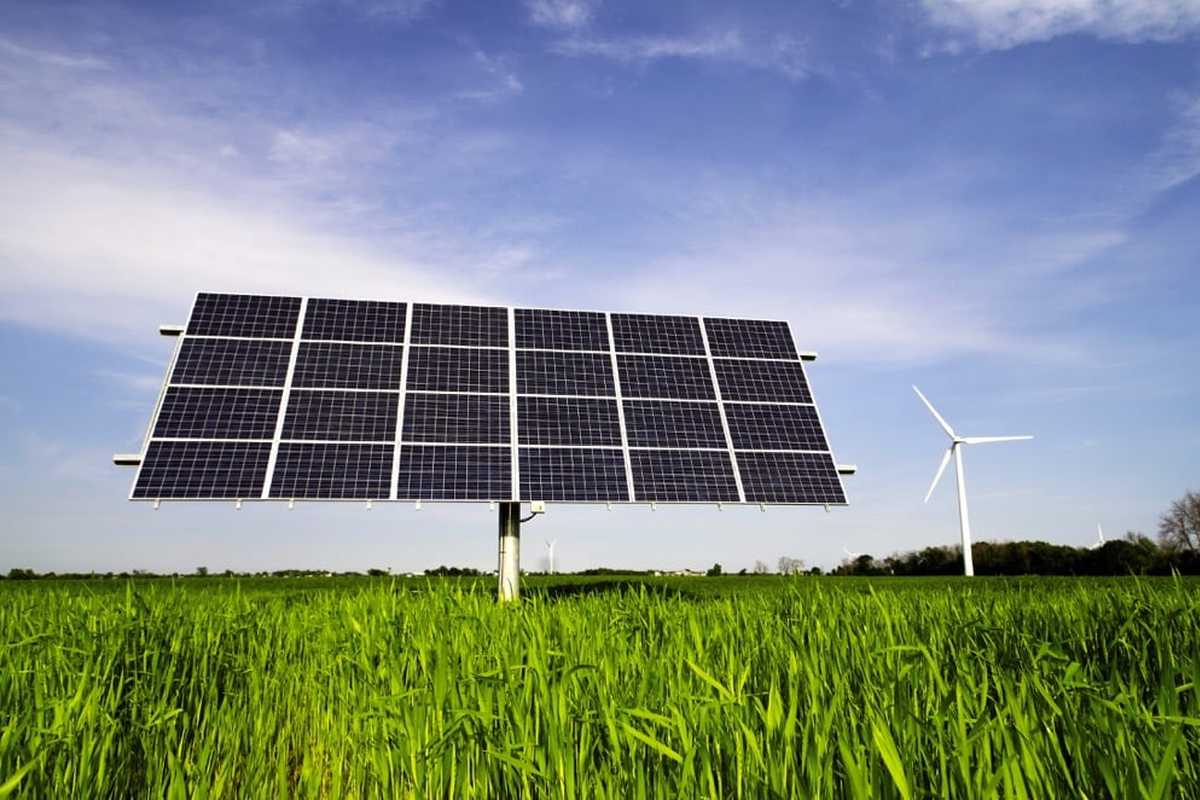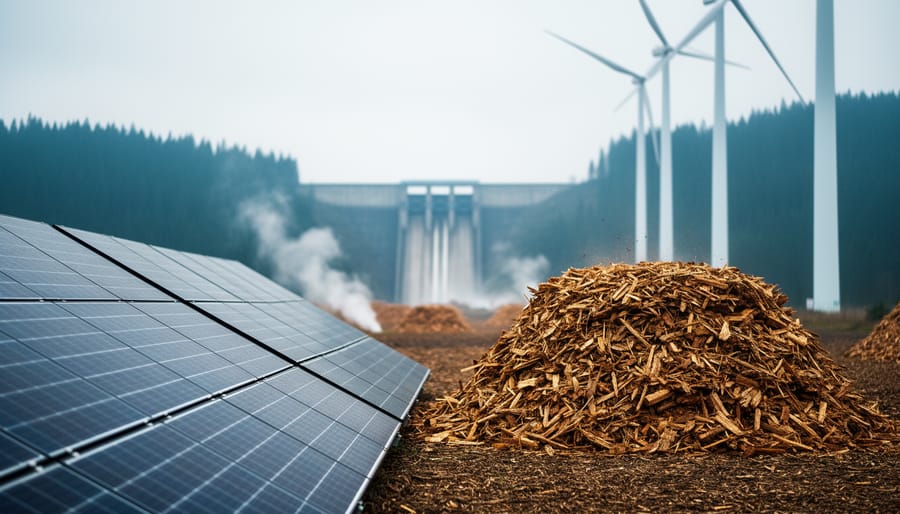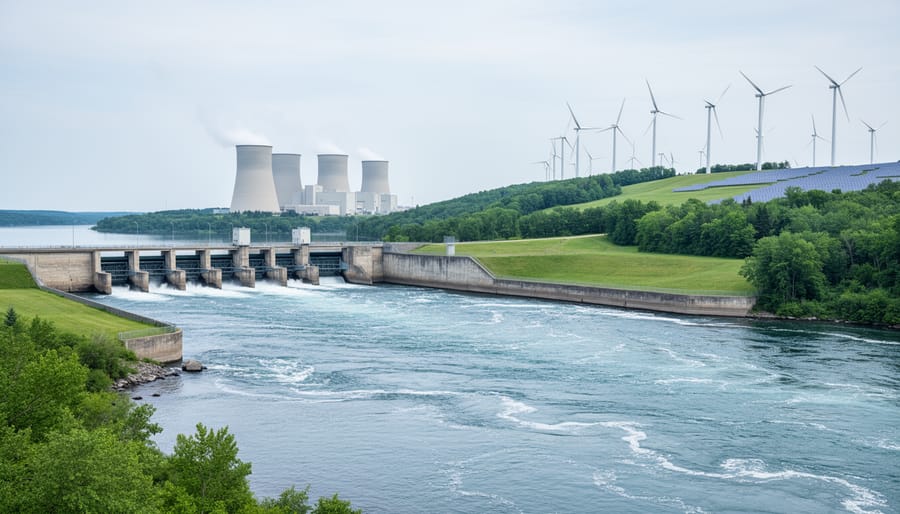
Ontario’s clean energy landscape tells a story of transformation that began over a century ago and continues to evolve today. The province stands out in North America for generating over 90% of its electricity from non-emitting sources, a achievement rooted in three primary renewable and low-carbon technologies: hydroelectric power, nuclear energy, and wind generation complemented by solar.
This energy mix reflects both geography and deliberate policy choices. The same Shield rivers that once powered Ontario’s mining frontier now drive turbines across the province. Nuclear facilities, dependent on Canadian uranium and nickel components for reactor systems and future battery storage, provide stable baseload power. Wind farms have expanded rapidly across rural and Indigenous territories, often through partnership models that share benefits directly with host communities.
Understanding these three sources matters because they connect directly to Ontario’s resource economy. The nickel extracted from Sudbury and other mining districts doesn’t just support global battery production. It plays a critical role in the energy storage systems that make intermittent renewables viable and in the specialized alloys used in both nuclear reactors and renewable infrastructure.
For professionals in natural resources, policymakers, and communities considering renewable projects, these technologies represent tested pathways rather than experimental concepts. Each source operates at commercial scale across Ontario today, supported by decades of engineering experience and increasingly by Indigenous-led energy corporations. The province’s transition away from coal, completed in 2014, proved that large-scale energy transformation is possible when technology, policy, and community interests align.
The question isn’t whether renewable energy works in Ontario. It’s how we build on this foundation collaboratively and equitably.
Hydroelectric Power: Ontario’s Renewable Foundation
The Infrastructure Behind the Flow
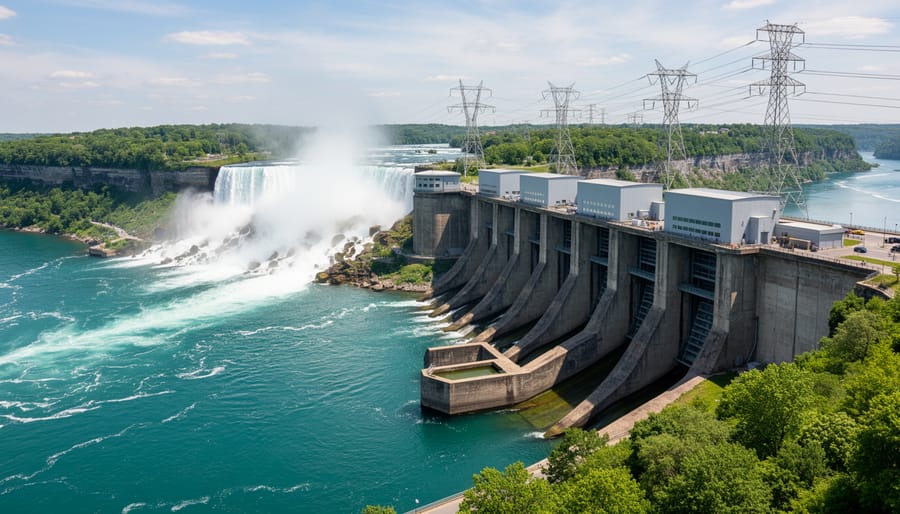
Ontario’s hydroelectric backbone rests on a network of facilities that span from the thundering Niagara escarpment to remote river systems across the Canadian Shield. The province’s generating capacity concentrates at strategic points where geography and engineering converge to transform flowing water into reliable electricity.
At Niagara Falls, the Sir Adam Beck stations anchor southern Ontario’s clean power supply. These facilities channel water from above the falls through underground tunnels to massive turbines, generating over 2,000 megawatts of continuous power without releasing carbon emissions. The system operates around the clock, drawing from the Niagara River’s consistent flow while maintaining the iconic waterfall’s scenic volume during daylight hours through international agreements.
Northern Ontario contributes through a different approach. Facilities along the Ottawa River, Mattagami River, and other watersheds operate as run-of-river systems or use reservoirs to manage seasonal variations in water flow. These installations provide power to remote communities and feed the provincial grid, with some facilities co-managed through partnerships that recognize Indigenous territorial rights and traditional knowledge about watershed management.
Together, these facilities form an integrated system. Grid operators balance output between southern generating stations and northern installations based on demand patterns, water availability, and seasonal conditions. This distributed network creates resilience, ensuring that maintenance at one facility or low water levels in one region do not compromise provincial electricity supply.
Indigenous Communities and Water-Based Energy
Water has always been sacred to First Nations communities across Ontario, and today’s hydroelectric projects require meaningful partnerships that honour both this spiritual significance and treaty rights. Many existing facilities sit on lands covered by historical treaties, and the Crown’s duty to consult Indigenous groups has reshaped how water-based energy projects move forward in 2026.
Communities like Moose Cree First Nation have moved beyond consultation to ownership. Their partnership in the Lower Mattagami hydroelectric project represents a shift from exclusion to equity, where revenue sharing and decision-making authority replace token engagement. These arrangements recognize that Indigenous knowledge about seasonal water flows, fish migration patterns, and ecosystem health strengthens project design rather than simply complicating it.
Treaty considerations extend beyond land use to water rights themselves. The Robinson-Huron and Robinson-Superior treaties, signed in 1850, didn’t anticipate industrial-scale water diversion, creating ongoing legal questions about how hydroelectric operations affect treaty promises. Progressive energy companies now work with Anishinaabe communities to establish environmental monitoring programs led by Indigenous technicians, ensuring that power generation doesn’t compromise fisheries or disrupt traditional waterways.
Northern Ontario’s remote hydroelectric stations increasingly employ local Indigenous workers and prioritize training programs that build technical expertise within communities. This approach transforms energy infrastructure from an imposed presence into a source of sustainable employment and economic self-determination.
The most successful partnerships share common ground: they start conversations early, respect traditional governance structures, and build flexibility into agreements so relationships can evolve as circumstances change. When Indigenous communities help shape how Ontario harnesses water for clean energy, the result benefits both the grid and the people whose territories sustain it.
Nuclear Energy: Ontario’s Clean Baseload Backbone
Why Nuclear Matters in the Renewable Conversation
Nuclear energy occupies a unique position in Ontario’s clean energy landscape. While wind and solar have captured public imagination, they share a fundamental limitation: they generate power only when conditions allow. Wind turbines sit idle on calm days. Solar panels produce nothing after sunset. This intermittency creates a challenge that nuclear power solves.
Ontario’s nuclear fleet operates continuously, delivering approximately 12,000 megawatts of carbon-free electricity around the clock. This baseload stability allows the grid to accommodate variable renewables without compromising reliability. When solar output drops in the evening and demand peaks, nuclear maintains consistent generation. During winter cold snaps when wind resources fluctuate, nuclear stations continue their steady supply.
The distinction matters for climate goals. Nuclear produces no greenhouse gas emissions during operation, matching renewables in environmental performance while providing the dependability that keeps lights on during Ontario’s coldest nights and hottest afternoons. This complementary relationship transforms what might seem like competing technologies into collaborative partners.
Grid operators describe nuclear as the foundation that makes higher renewable penetration possible. Without this reliable backbone, utilities would need fossil fuel plants as backup, undermining decarbonization efforts. By 2026, Ontario’s integrated approach demonstrates how nuclear and renewables work together rather than in opposition, creating a resilient system that delivers both environmental benefits and energy security.
The Nickel-Nuclear Connection
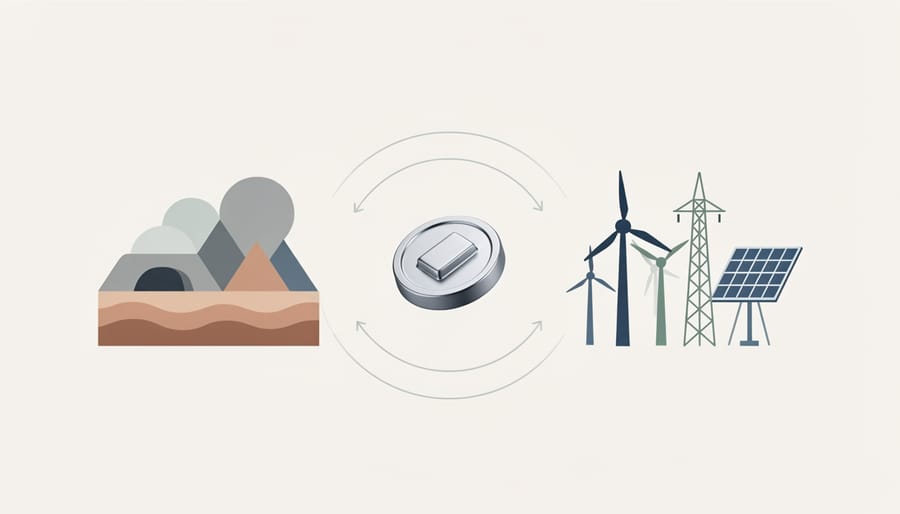
Canadian nickel plays a surprisingly vital role in nuclear energy infrastructure, creating a direct connection between Ontario’s mining sector and its clean energy production. The same corrosion-resistant properties that make nickel essential for renewable energy components also make it indispensable in nuclear reactor systems.
Nuclear reactors operate in extraordinarily harsh environments, extreme temperatures, high pressure, and constant radiation exposure. Nickel-based alloys withstand these conditions where ordinary steel would fail. Primary heat transport systems, which carry coolant through the reactor core, rely on nickel-chromium-iron alloys that resist corrosion at temperatures exceeding 300°C. These specialized materials maintain structural integrity for decades, ensuring safe, reliable operation.
Steam generators, which transfer heat from the reactor to produce electricity, incorporate nickel alloys in their thousands of tubes. The material’s resistance to stress corrosion cracking prevents failures that could compromise reactor efficiency or safety. Similarly, reactor vessel components and fuel channel assemblies use nickel-containing stainless steels that remain stable under neutron bombardment and thermal cycling.
Ontario’s position as both a nuclear energy leader and a major nickel producer creates unique opportunities. The Sudbury Basin, one of the world’s premier nickel mining regions, supplies material that eventually returns to support the province’s clean energy systems. Companies extracting nickel for battery manufacturing simultaneously serve the nuclear sector, demonstrating how critical minerals underpin multiple pathways to decarbonization.
This connection extends to emerging technologies. Small modular reactors, currently under development in Ontario, will require the same corrosion-resistant materials as traditional plants. As nuclear refurbishment projects advance at Bruce Power and Darlington, demand for responsibly sourced Canadian nickel continues, a testament to how resource extraction and clean energy production form an integrated system rather than separate industries.
Ontario’s Nuclear Refurbishment and Future
Ontario is betting big on nuclear’s future. Bruce Power’s $13 billion refurbishment program, which began in 2016, will extend the plant’s lifespan to 2064 while maintaining its position as the world’s largest operating nuclear facility. Darlington’s four-unit refurbishment, running through 2026, ensures another 30 years of carbon-free baseload power for the province.
Beyond traditional reactors, Ontario is pioneering small modular reactor technology. Ontario Power Generation’s Darlington site will host Canada’s first grid-scale SMR, with construction expected by 2028. These compact reactors promise safer designs, reduced construction timelines, and potential deployment in remote communities currently reliant on diesel generators, including northern Indigenous communities exploring clean energy alternatives.
This investment secures Ontario’s clean electricity backbone well into the 2050s, supporting growing demand from electric vehicle adoption and industrial electrification while maintaining the grid stability that intermittent renewables can’t provide alone.
Wind and Solar: Ontario’s Growing Renewable Pair
Wind Energy Across Ontario’s Landscape
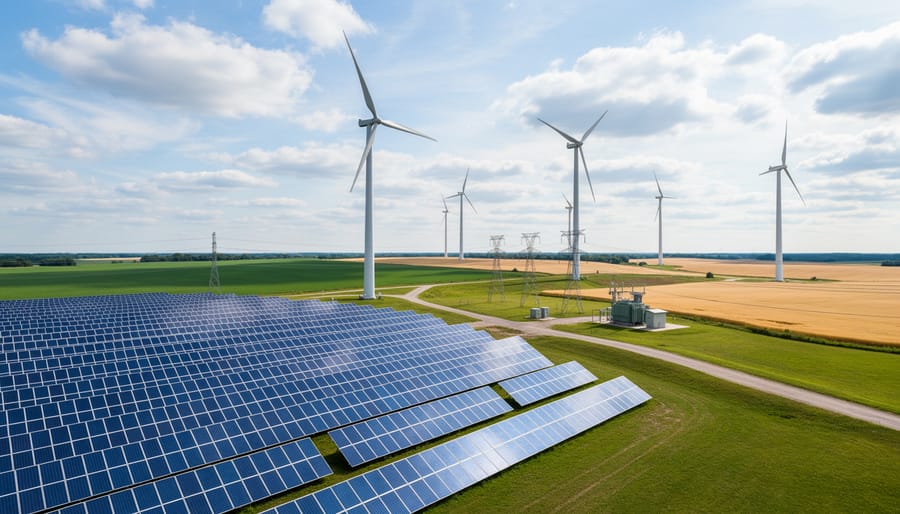
Wind power has carved out a significant presence across Ontario’s diverse geography, from the flat farmlands of the southwest to remote northern settlements. As of 2026, the province hosts approximately 2,500 megawatts of installed wind capacity distributed across more than 40 wind farms, making it a visible and increasingly important component of Ontario’s renewable portfolio.
The southwestern corridor, stretching from Windsor through Huron and Bruce counties to the Niagara region, contains the densest concentration of turbines. This placement isn’t accidental. Consistent winds sweeping across Lake Erie and Lake Huron create ideal conditions, while the relatively flat agricultural terrain simplifies construction and maintenance. Farmers often welcome wind installations because turbines occupy minimal ground space. A single turbine foundation typically claims less than half an acre, allowing crops or grazing to continue right up to the base while generating steady lease payments that supplement agricultural income.
Northern Ontario presents a different wind story. Communities like Moose Cree First Nation operate smaller installations that serve local energy needs and reduce diesel dependency. These projects frequently incorporate community benefit agreements that extend beyond simple land payments. Training programs employ local residents in turbine maintenance, revenue-sharing arrangements fund community infrastructure, and governance structures give Indigenous communities decision-making authority over operations.
Wind farms near population centres sometimes face resistance over visual impact and noise concerns, yet many projects have evolved through genuine consultation processes. Setback distances, acoustic monitoring, and decommissioning bonds have become standard features that address community concerns while allowing wind energy to expand its contribution to Ontario’s clean power mix.
Solar Power’s Rising Contribution
Solar power has transformed from a niche technology into a meaningful contributor to Ontario’s energy mix, with installed capacity reaching approximately 3,700 megawatts in 2026. Unlike wind energy’s northern expansion, solar installations concentrate in southern Ontario where population density and sunlight exposure align most favorably.
Utility-scale solar farms now dot agricultural regions from Essex County to Prince Edward County, often operating on dual-use farmland where panels coexist with livestock grazing or crop cultivation beneath elevated arrays. These projects typically range from 50 to 300 megawatts, feeding directly into the provincial grid during daylight hours when electricity demand historically peaks.
Distributed rooftop systems represent solar’s other growth frontier. Commercial warehouses, municipal buildings, and residential properties across the province have added panels as installation costs dropped nearly 60 percent since 2020. Net metering programs allow these smaller systems to offset consumption while feeding excess generation back to the grid, creating thousands of mini power plants that collectively reduce strain during hot summer afternoons.
Solar’s timing advantage proves crucial for grid management. Generation peaks between 11 AM and 3 PM, precisely when air conditioning drives demand upward in Ontario’s urban centers. This natural alignment reduces reliance on natural gas peaker plants that would otherwise fill the gap, cutting emissions during the day’s most energy-intensive hours.
Technological improvements continue extending solar’s reach. Bifacial panels capturing reflected light from snow cover, tracking systems that follow the sun’s arc, and improved efficiency in low-light conditions have all boosted winter performance in Ontario’s challenging climate.
The Materials Behind Renewable Technology
Renewable energy infrastructure depends on a complex supply chain of critical minerals, many sourced right here in Canada. Wind turbines require rare earth elements like neodymium for their powerful permanent magnets, while solar panels need high-purity silicon and silver for efficient energy conversion. Copper runs through every renewable system as the primary conductor in wiring and transmission lines.
Nickel plays an especially vital role in energy storage. Lithium-ion batteries that store excess solar and wind power rely on nickel-rich cathodes for their energy density and longevity. Ontario’s nickel mines supply this essential material, creating a direct link between sustainable mining practices and renewable energy deployment. As battery storage expands to balance intermittent renewable sources, demand for responsibly sourced nickel continues to grow, positioning Canadian mining operations as critical partners in the clean energy transition.
How These Three Sources Work Together
Ontario’s electricity grid functions as a carefully choreographed system where each renewable source plays to its strengths, creating reliability that no single technology could achieve alone. Nuclear power provides the steady, round-the-clock foundation, what grid operators call baseload power, that keeps hospitals, data centres, and manufacturing running regardless of weather or time of day. Hydroelectric facilities add flexibility that nuclear cannot match, ramping output up or down within minutes to meet shifting demand throughout the day. When Ontarians come home from work and turn on appliances, hydroelectric stations can quickly increase generation to meet that evening peak.
Wind and solar bring their own distinct patterns to this energy partnership. Solar generation peaks during midday when commercial buildings need cooling and lighting, directly offsetting demand during those hours. Wind energy tends to blow stronger at night and during shoulder seasons, complementing solar’s daytime contribution. Together, they reduce the load on baseload sources during favourable conditions.
The challenge lies in managing intermittency, those periods when the wind doesn’t blow and clouds cover solar panels. This is where the partnership between all three sources becomes critical. Hydroelectric reservoirs essentially function as giant batteries, storing energy by holding water until needed. When renewable generation exceeds demand, excess power can pump water into elevated reservoirs for later release.
Seasonal variations add another layer of complexity. Winter in Ontario means higher electricity demand for heating precisely when solar output drops due to shorter days and snow cover. Nuclear and hydroelectric carry more of the load during these months, while summer brings stronger solar performance when air conditioning drives peak demand. Spring runoff increases hydroelectric capacity just as heating needs decline.
The Independent Electricity System Operator monitors this intricate balance second by second, directing which sources contribute to the grid at any moment. This real-time coordination ensures Ontarians receive reliable, increasingly clean electricity regardless of weather patterns or seasonal shifts.
What This Means for Ontario’s Energy Future
Ontario’s three renewable energy pillars create a foundation that extends far beyond electricity generation. The province’s robust mix of hydroelectric, nuclear, and wind/solar power positions it as a testing ground for large-scale electrification that other jurisdictions are watching closely.
The transportation sector represents the most immediate opportunity. As electric vehicle adoption accelerates across Canada, Ontario’s clean grid means EVs charged here produce significantly lower lifecycle emissions than those powered by coal or gas-heavy grids elsewhere. This advantage attracts battery manufacturers and automotive companies investing in North American production, creating jobs while reducing the carbon footprint of transportation.
Industrial electrification follows a similar pattern. Energy-intensive sectors like steel production and chemical manufacturing are exploring electric processes that were impractical with fossil fuel grids. Ontario’s stable, low-carbon electricity supply makes these transitions economically viable, particularly as carbon pricing increases the cost of emissions-heavy alternatives.
The economic ripple effects reach into mining and manufacturing. Demand for nickel, copper, lithium, and cobalt continues rising as renewable infrastructure expands. Ontario’s mining sector, already producing nickel essential for both nuclear reactors and battery systems, benefits from this global transition while Indigenous communities increasingly shape how these resources are developed and shared.
Meeting Canada’s 2030 emissions targets requires provinces to demonstrate scalable solutions. Ontario’s model shows that combining reliable baseload nuclear with flexible hydroelectric and growing wind/solar capacity can power modern economies without depending on fossil fuels. The challenge ahead is not whether Ontario can maintain clean electricity, but how quickly it can expand capacity to meet surging demand from electrification across all sectors.
Ontario’s renewable energy landscape reveals a fundamental truth: sustainable power and responsible resource development are two sides of the same coin. Hydroelectric infrastructure, nuclear facilities, and expanding wind and solar installations all depend on materials extracted from the earth, nickel for reactor components and battery storage, copper for transmission systems, rare earths for turbine magnets. This dependency creates an opportunity for Canada to demonstrate how clean energy and mining can advance together rather than in opposition.
The three energy sources examined here succeed partly because they reflect collaborative approaches. Indigenous communities participate as partners in hydroelectric projects, benefit from wind farm agreements, and contribute traditional ecological knowledge to resource management decisions. This model of shared stewardship strengthens both energy security and reconciliation.
As Ontario moves deeper into electrification, powering more vehicles, heating more buildings, and supporting more industry with clean electrons, these renewable pillars will carry greater loads. Meeting that demand sustainably requires the same balanced approach: extracting necessary materials responsibly, generating power with minimal environmental impact, and ensuring communities share in the prosperity that clean energy creates. The transition to a low-carbon economy isn’t just about what we build, but how we build it together.